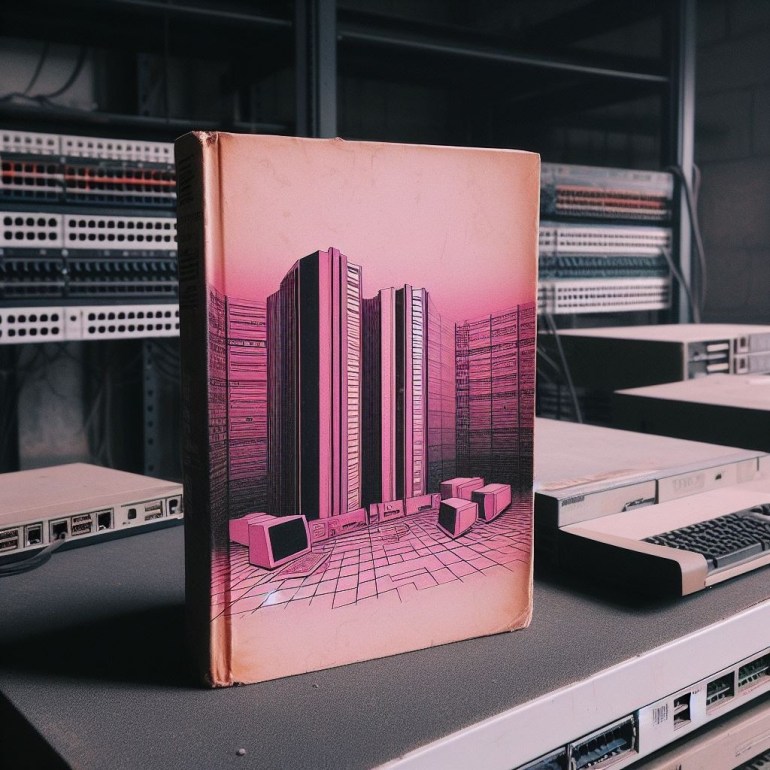
I wrote this book in November 2023, out of the NaNoWriMo challenge, where you have to write 50.000 words in a month, or 1.600 words every day for the whole November. I have always wanted to share my work experience within the technology realm, mostly due to being a white fly and never really fitting the stereotype of computer geek, but also because I have genuinely loved all my jobs, the experiences I have made and the people I met. I was lucky, I know, but also maybe smart enough to run from difficult moments and humble enough to always ask for help and find people (mostly men) willing to help me navigate this tough world.
Because of my technology obsession, I wanted to use ChatGPT, to increase speed and improve my English (being non native it’s not always easy to find the right words), and in the end I decided to also include the prompts (for those who are not familiar with AI, prompts are the questions posed to it, in order to shape the response in the way you want it) to make this experiment a shared one. I have reviewed both, the prompts and the responses, to match my train of thought and make it more readable, but in any case, you already know you wouldn’t get the same answers twice. 😊
Also, I have changed some of the character names to respect a bit of privacy but most of the facts are true and maybe sometimes just embellished to make them funnier to read.
Enjoy the ride, and the tech thrill of yet another technology breakthrough!
Write with a sarcastic, friendly, witty and feminist tone, no dialogues, an intro to this book. It’s about the experience of a technical female professional spanning the 90 and 2000s and up to this day, and it’s filled with anecdotes and funny situations but also a spark scoring of the D&I experience through the lens of today’s standards.
Introduction
Welcome, dear reader, to a journey through the annals of technology, where bits and bytes intertwine with the sassy keystrokes of a young woman navigating the digital wilderness. In this compendium of wit, sarcasm, and unapologetic feminism, we embark on an odyssey spanning the ’90s, the tumultuous 2000s, and up to the present day. Brace yourself for a rollercoaster ride filled with anecdotes, technical escapades, and a no-holds-barred exploration of diversity and inclusion through the acerbic lens of today’s standards.
Our journey kicks off in the ’90s, an era when the internet was a nascent realm, and women in tech were as rare as a glitch-free operating system. Our intrepid heroine, armed with a 1200-baud modem and a penchant for defying stereotypes, dives headfirst into the world of bulletin board systems (BBS). Picture a tech-savvy sorceress, weaving connections with fellow wizards in a niche realm where code was the language of friendship.
Fast forward to the late ’90s, an epoch where the telecommunications dance floor beckoned. Our protagonist, now a 21-year-old gal with good computer skills, pirouettes through a sea of bewildered onlookers who can rarely fathom a woman leading the IT conversation. Oh, the symphony of sarcastic remarks and raised eyebrows, as our leading lady dismantles PBXs adjuncts with wit and satisfaction.
As the new millennium dawns, our fearless tech maven transitions to a role in customer support for a telco company. The yawns and gasps from skilled and unskilled users become a comedic backdrop to her days, with IVR systems playing the supporting role. A cacophony of problems and patches and the occasional user-from-hell provide the punchlines in this uproarious comedy of errors.
Our tale then shifts to a new frontier in telecommunications – the Centers of Excellence (CoE) for Tier III engineers. Our protagonist ascends to the upper echelons of tech stardom, flying business class, reveling in 5-star hotels, and facing the dichotomy of boredom and burnout. The glory days of solving mission-critical issues by the lake or swapping tapes in a vault become the anecdotes that pepper this chapter.
A tempting offer from a rival company lures our protagonist away from Nortel Networks. A product manager’s role beckons, promising no nightly duty calls and a hefty paycheck. The transition is seamless, and the initial months are a whirlwind of navigating a larger subsidiary. The narrative pivots to a new role in 2001, as our tech virtuoso enters the realm of Nortel Networks and the complexities of its switch. Analog and digital telephony make space for VoIP to take center stage, with our heroine decoding the intricacies of serial or IP connections to specialized adjuncts. The tech landscape evolves, and so does our leading lady’s prowess. However, the abrupt turn of events post-9/11 throws our heroine into a whirlpool of rumors, layoffs, and a sudden end to the newfound role.
A Cisco partner (and its technology), Dimension Data, becomes the next chapter in our protagonist’s journey, a realm of IP telephony breakthroughs and the birth of the Cisco IPCC. The early 2000s usher in a new era of technology, and our leading lady is at the forefront, navigating the complexities with humor and a flair for the dramatic. The narrative unfolds as a startup venture, complete with acquisitions, travels, and the exhilaration of managing a team. The camaraderie with old pals from the BBS days adds a touch of nostalgia to this chapter.
As the recession of 2008 hits, our protagonist has already entered the world of Aspect, an American giant in the contact center business, but unknown,and a startup in the southern European market. The initial years are a whirlwind of learning, travel, and collaboration, only to face the harsh realities of downsizing an already small startup. The sudden departure of a mentor leaves a void, and the struggle to find meaning in corporate decisions becomes a prevalent theme.
The final act of the 2010s unfolds, with our heroine juggling the demands of a burgeoning family and a demanding job. The unexpected loss of a parent adds a somber note, and the protagonist finds solace in work as a distraction from personal grief.
A reflection on the Discrimination and Inclusion (D&I) score becomes the prelude to the MaaS (Mother as a Service) manifesto. All jobs are dissected with a feminist lens, sparking a call to rewrite societal narratives and usher in an era of equality. As you flip through the pages of this tech-driven epic, prepare to be regaled with tales of coding escapades, telecommunication triumphs, and the tumultuous journey of a woman thriving in a male-dominated landscape. Join our protagonist as she navigates the digital realm with a blend of humor, sarcasm, and unyielding feminism, leaving an indelible mark on the binary tapestry of the tech wonderland.
This year, I’m diving headfirst into the literary jungle, armed with a keyboard and a decade-spanning tech tale as my trusty sidekick! I’m taking on NaNoWriMo 2023 with lots of good intentions, and a clear mission: writing a book about my rollercoaster journey as a tech-savvy gal from the ’90s to the present day.
This is a story of floppy disks, dial-up modems, and the perpetual quest for more pixels (and bandwidth) that I have been meaning to write for a very long time.
And guess what, I’ve got a secret weapon up my sleeve – ChatGPT as my co-pilot! With its AI wizardry, I’m turbocharging my writing process faster than you can say “Ctrl+Alt+Delete.”
This will totalle make up for my chronic lack of time: ideas are already in my head, and with the copilot help, it will be much easier to put them into words – also writing in English which is a second language to me. 🙂
So, buckle up, fellow writers and readers, because this book is going to be a wild ride through the digital ages, with just the right dash of nerdy humor to keep you entertained!
Let the typing begin! 🚀💾🤖 #NaNoWriMo #TechTales #ChatGPTAdventures
Very often I have meetings and discussions with customers who have developed their own flavour of CX software and ask if and why should they change to a vendor’s standard solution. Depending on the size of the company, I see a trend with moving to standardized software rather than keeping the customized developments. Developing a home-grown application has the initial and great advantage of starting with few targeted capabilities that are critical and specific to the company; also, it bears a smaller commercial footprint, and last but not least the ability to add features as the business users ask, step by step and independently from any product market trend.
So my answer to those customer is: it depends. What is as good as a tailored suit today, may not fit tomorrow.
What happens when the company evolves and increases in complexity, typically leads to many issues with the home-grown application:
Maintenance: as the application was originally based on functionality requests coming from the internal users, at some point of the complexity curve it may become very difficult to keep up with the pace of the new requests, so when the deployment cycle has just finished for one set of features, the developers’ team is already late for the new batch.
Features: when the new application has a very basic set of capabilities, it’s kind of difficult to realize what would be needed and what can be achieved outside the narrow targeted scope, which makes it difficult to plan upgrades and developments.
Timing: in order to reach 100% of feature availability, this could really take months of development, moving the return of investment to a wider time-frame.
Trust in the software algorithm: if the developed solution at some point starts to seem weak, this risks mining the entire project and any future evolution: better having less safe features than risk the users trust.
Scalability and performance: tools that were originally intended for a specific number of users sometimes cannot simply scale or provide adequate performances when running on larger users groups.
So there is, in my experience, a sweet spot when a customer is tired of maintaining the home-grown solution and eager for more standardized products, but at the same time with a fully expert team of developers who can really use the new solution at 100%. Swapping to a vendor’s solution at the right time will have the effect of letting the internal team specialize on customizations and small developments, while focusing on the company’s core business. Precious and high skilled resources can then be used to focus on new ways of using the technology, rather than spend lot of time with Q&A and application maintenance.
The other day I was on public transportation and obviously everyone was tapping on their smartphone, included myself, when I realized someone was loudly talking on their phone. In a place packed with people, a middle aged lady, presumably a psychologist, was discussing a clynic case with lots of detailed information about some poor guy. Then after a few moments, a young lady was making a couple of private appointments, with loads of information we really did not want to hear.
The reaction of the whole audience was:
1. heads up from the smartphone
2. show indifferent/annoyed/amused stare to the loud-talking people
3. a guy actually swapped place fuming as evidently realized he really did not want to hear the conversation.
This made me think that I usually tend to make my phone conversations with sensitive information very private, as in “home-office-when-nobody-else-is-at-home” privacy, and otherwise any other information exchange with other people happens on other media. And I kind of like that so much, that I was in the annoyed/amused reaction while listening to stuff that now I cannot un-hear.
Whenever you need to communicate you often have the choice to define the context, and based on this, to decide what channel best suits the interaction. Digital helps people keep their privacy, sometimes. (yes I know that it defies privacy in other ways, but still) Companies should be able to understand the psychology that is behind every channel choice and this kind of information is highly useful to plan the CX journey, as you are able to get the most out of every media, for what the media is actually and beneficially used for.
Context is key to correctly mapping the journey and the business drivers related to it, and should be considered first when planning a CX optimization process.
When talking to customers and partners about digital channels, I rarely hear composed expressions like “Oh sure we have those, there is a strategy and a plan, and a complete map of the customer journey, and all is perfect, thanks”.
In fact, the answers I get most of the times are more like “we have no clue on what to do, and our customer journey is completely random”. Which, you guys, is good news! A random customer journey means that your customers are still willing to spend time browsing through your available channels, despite sometimes being stuck somewhere, or getting the wrong answers. They believe in your company, and in the fact that at some point you will see that they are using all of the digital channels (for the engineers, more about naming convention in one of my latest posts), and improve their service following their choices.
Obviously, the target of any company is to drive the journey, and guide customers through it, by completely mastering their jumping from one channel to the other, while measuring impact and effectiveness with smart dashboards and stats. But in real life, there are very few customers at this stage, and also, you need to know that this stage is not final. It is just a step, in a cyclic process of optimization of the CX, that at some point will need to dynamically adapt, according to the many variables that move, in real time, within the company’s and the customers’ fast environments.
If the good news is you have a random journey, or call it a window of opportunity, the bad news is there is a lot of work to do, and usually it has little technology involved (although with the right technology the mapping is a lot easier and faster). Most of the work is, in fact, related to internal and external processes that have an impact on the journey, and to putting together all the departments that are not willing to talk to each other because, historically, they were never related. Today, all your communication-driven processes, internal and external to the company (I would dare to say all of them: is there any part of your business still without communication?) need to be integrated and consistent because this is the image reflected through an omni-channel customer care. So if you have offered multiple channel access to your customers in a random way and still have people browsing through it, it’s time to plan for a thoughtful and thorough assessment and re-design of your CX, before they change their mind and go to the competition’s random journey.
“He had found a Nutri-matic machine which had provided him with a plastic cup filled with a liquid that was almost, but not quite, entirely unlike tea. The way it functioned was very interesting. When the Drink button was pressed, it made an instant but highly detailed examination of the subject’s taste buds, a spectroscopic analysis of the subject’s metabolism and then sent tiny experimental signals down the neural pathways to the taste centres of the subject’s brain to see what was likely to go down well. However, no one knew quite why it did this, because it invariably delivered a cupful of liquid that was almost, but not quite, entirely unlike tea.” (Douglas Adams, The Hitch-hiker’s Guide to the Galaxy)
One occurrence is not significant. This really sums up our feelings towards customer experience. If we happen to find the unicorn of CX, where everything runs smoothly and is fabulous and neat, we will still rant about the other 99% of occasions which left us sour-mouthed.
And why is that? I mean why can’t we brag about one nice experience and make it up for the other fails? I guess the answer is bordering philosophy and the fact that there is an intrinsic lightness to our experiences with companies and providers.
Or is it just that companies and providers are not making the effort and don’t deserve our feelings nor to be considered meaningful?
For now on, my resolve will be to spot any good CX and post it here, so it is no longer non-significant, at least for a few bytes. 🙂







 nevermindthedigital