The Pink Datacenter – Introduction

Foreword

I wrote this book in November 2023, out of the NaNoWriMo challenge, where you have to write 50.000 words in a month, or 1.600 words every day for the whole November. I have always wanted to share my work experience within the technology realm, mostly due to being a white fly and never really fitting the stereotype of computer geek, but also because I have genuinely loved all my jobs, the experiences I have made and the people I met. I was lucky, I know, but also maybe smart enough to run from difficult moments and humble enough to always ask for help and find people (mostly men) willing to help me navigate this tough world.

Because of my technology obsession, I wanted to use ChatGPT, to increase speed and improve my English (being non native it’s not always easy to find the right words), and in the end I decided to also include the prompts (for those who are not familiar with AI, prompts are the questions posed to it, in order to shape the response in the way you want it) to make this experiment a shared one. I have reviewed both, the prompts and the responses, to match my train of thought and make it more readable, but in any case, you already know you wouldn’t get the same answers twice. 😊

Also, I have changed some of the character names to respect a bit of privacy but most of the facts are true and maybe sometimes just embellished to make them funnier to read.

Enjoy the ride, and the tech thrill of yet another technology breakthrough!

Write with a sarcastic, friendly, witty and feminist tone, no dialogues, an intro to this book. It’s about the experience of a technical female professional spanning the 90 and 2000s and up to this day, and it’s filled with anecdotes and funny situations but also a spark scoring of the D&I experience through the lens of today’s standards.

Introduction

Welcome, dear reader, to a journey through the annals of technology, where bits and bytes intertwine with the sassy keystrokes of a young woman navigating the digital wilderness. In this compendium of wit, sarcasm, and unapologetic feminism, we embark on an odyssey spanning the ’90s, the tumultuous 2000s, and up to the present day. Brace yourself for a rollercoaster ride filled with anecdotes, technical escapades, and a no-holds-barred exploration of diversity and inclusion through the acerbic lens of today’s standards.

Our journey kicks off in the ’90s, an era when the internet was a nascent realm, and women in tech were as rare as a glitch-free operating system. Our intrepid heroine, armed with a 1200-baud modem and a penchant for defying stereotypes, dives headfirst into the world of bulletin board systems (BBS). Picture a tech-savvy sorceress, weaving connections with fellow wizards in a niche realm where code was the language of friendship.

Fast forward to the late ’90s, an epoch where the telecommunications dance floor beckoned. Our protagonist, now a 21-year-old gal with good computer skills, pirouettes through a sea of bewildered onlookers who can rarely fathom a woman leading the IT conversation. Oh, the symphony of sarcastic remarks and raised eyebrows, as our leading lady dismantles PBXs adjuncts with wit and satisfaction.

As the new millennium dawns, our fearless tech maven transitions to a role in customer support for a telco company. The yawns and gasps from skilled and unskilled users become a comedic backdrop to her days, with IVR systems playing the supporting role. A cacophony of problems and patches and the occasional user-from-hell provide the punchlines in this uproarious comedy of errors.

Our tale then shifts to a new frontier in telecommunications – the Centers of Excellence (CoE) for Tier III engineers. Our protagonist ascends to the upper echelons of tech stardom, flying business class, reveling in 5-star hotels, and facing the dichotomy of boredom and burnout. The glory days of solving mission-critical issues by the lake or swapping tapes in a vault become the anecdotes that pepper this chapter.

A tempting offer from a rival company lures our protagonist away from Nortel Networks. A product manager’s role beckons, promising no nightly duty calls and a hefty paycheck. The transition is seamless, and the initial months are a whirlwind of navigating a larger subsidiary. The narrative pivots to a new role in 2001, as our tech virtuoso enters the realm of Nortel Networks and the complexities of its switch. Analog and digital telephony make space for VoIP to take center stage, with our heroine decoding the intricacies of serial or IP connections to specialized adjuncts. The tech landscape evolves, and so does our leading lady’s prowess. However, the abrupt turn of events post-9/11 throws our heroine into a whirlpool of rumors, layoffs, and a sudden end to the newfound role.

A Cisco partner (and its technology), Dimension Data, becomes the next chapter in our protagonist’s journey, a realm of IP telephony breakthroughs and the birth of the Cisco IPCC. The early 2000s usher in a new era of technology, and our leading lady is at the forefront, navigating the complexities with humor and a flair for the dramatic. The narrative unfolds as a startup venture, complete with acquisitions, travels, and the exhilaration of managing a team. The camaraderie with old pals from the BBS days adds a touch of nostalgia to this chapter.

As the recession of 2008 hits, our protagonist has already entered the world of Aspect, an American giant in the contact center business, but unknown,and a startup in the southern European market. The initial years are a whirlwind of learning, travel, and collaboration, only to face the harsh realities of downsizing an already small startup. The sudden departure of a mentor leaves a void, and the struggle to find meaning in corporate decisions becomes a prevalent theme.

The final act of the 2010s unfolds, with our heroine juggling the demands of a burgeoning family and a demanding job. The unexpected loss of a parent adds a somber note, and the protagonist finds solace in work as a distraction from personal grief.

A reflection on the Discrimination and Inclusion (D&I) score becomes the prelude to the MaaS (Mother as a Service) manifesto. All jobs are dissected with a feminist lens, sparking a call to rewrite societal narratives and usher in an era of equality. As you flip through the pages of this tech-driven epic, prepare to be regaled with tales of coding escapades, telecommunication triumphs, and the tumultuous journey of a woman thriving in a male-dominated landscape. Join our protagonist as she navigates the digital realm with a blend of humor, sarcasm, and unyielding feminism, leaving an indelible mark on the binary tapestry of the tech wonderland.

To be continued…

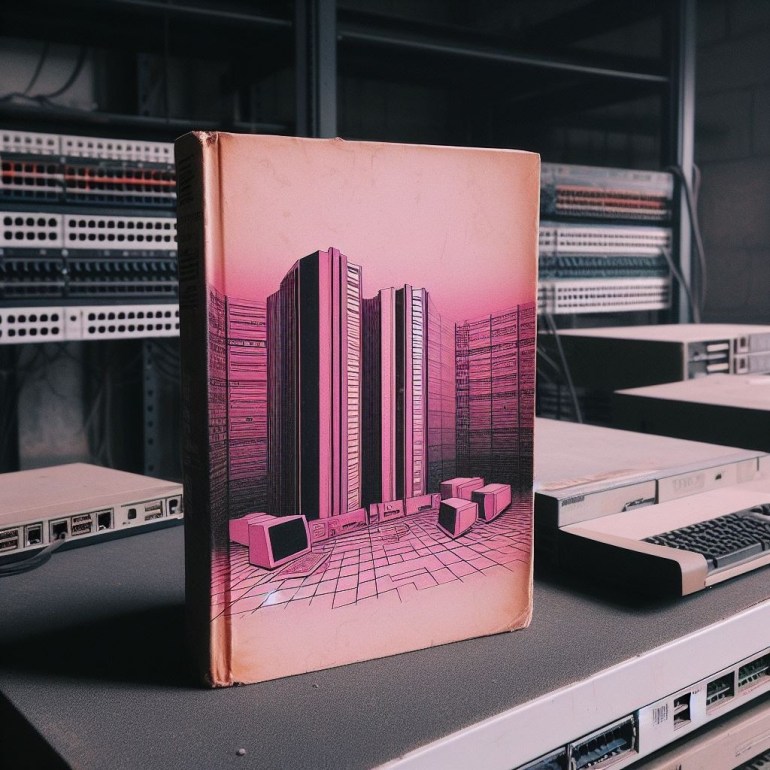
The Pink Datacenter – my book

📚 Introducing my New Book: “The Pink Datacenter”, written this last November for the NaNoWriMo initiative with the help of my friend the AI chatbot.

🚀 Over the years, I’ve accumulated a treasure trove of stories, anecdotes, and insights from the world of technology, and I can’t wait to share them with you. From the early days of the internet to the cutting-edge innovations of today, my book chronicles the adventures, challenges, and triumphs of navigating the ever-evolving landscape of tech with the wide-open eyes of a girl who loves technology.

📖 Starting this month, I’ll be publishing excerpts from the book right here on my blog, one paragraph at a time. Each snippet will offer a glimpse into the fascinating world of tech, with humorous anecdotes, witty observations, and valuable lessons learned along the way. Whether you’re a seasoned tech enthusiast or simply curious about the inner workings of the industry, or in search of a #girlintech role model, I guarantee there will be something for everyone in “The Pink Datacenter.”

✨ Stay tuned for my first installment this week, and get ready to embark on a journey through the highs and lows of the tech world like never before. With “The Pink Datacenter,” I invite you to join me as I explore the past, present, and future of technology, one paragraph at a time.

NaNoWriMo 2023 – the return of the tech girl

This year, I’m diving headfirst into the literary jungle, armed with a keyboard and a decade-spanning tech tale as my trusty sidekick! I’m taking on NaNoWriMo 2023 with lots of good intentions, and a clear mission: writing a book about my rollercoaster journey as a tech-savvy gal from the ’90s to the present day.

This is a story of floppy disks, dial-up modems, and the perpetual quest for more pixels (and bandwidth) that I have been meaning to write for a very long time.

And guess what, I’ve got a secret weapon up my sleeve – ChatGPT as my co-pilot! With its AI wizardry, I’m turbocharging my writing process faster than you can say “Ctrl+Alt+Delete.”

This will totalle make up for my chronic lack of time: ideas are already in my head, and with the copilot help, it will be much easier to put them into words – also writing in English which is a second language to me. 🙂

So, buckle up, fellow writers and readers, because this book is going to be a wild ride through the digital ages, with just the right dash of nerdy humor to keep you entertained!

Let the typing begin! 🚀💾🤖 #NaNoWriMo #TechTales #ChatGPTAdventures

https://nanowrimo.org/participants/paolaeva/projects/the-pink-datacenter/

The rise of the digital bookworm

I have always been an avid reader since the time my mom, for my 11th birthday, gave me a library card for a present. It was one of the best presents of my life.

In my youth I used to plan my holidays according to how many books I needed in my bags, and there was often a whole heavy piece of luggage dedicated to those papery things.

Fast forward to this summer, where I have totally embraced my e-reader and its entire philosophy.

Yes there is no “paper feeling”, and the old fashioned cover judgement is not really a viable option, but I was able to read almost incessantly for my entire holiday, thanks to the kids being a bit more manageable on the beach, and the fact that I could hop onto any public WiFi and buy the next book in no time.

How is that for a digital transformation? 🙂

Also, because I read books in English (it’s not my first language and it helps keeping up), in the past finding good paperback best sellers in English was something complicated in faraway seaside desolate lands, so it had to be solely planned in advance. If I finished my stack earlier I had to revert to Italian books from the local store, sometimes not even my genre.

In my rich three weeks’ vacation (the most I had in 10 years) I was able to devour a total of 12 books, which is more than I was ever able to accomplish even in my own mother tongue, even in the university days.

What is the point I’m trying to make? That this is exactly the core of a digital transformation: when the experience gets so immensely better than the non-digital (analogue? I still have that thing) that it reaches a point of no return, and you are transformed not only as an actor but also as the end-user of what this transformation is all about.

Embrace your e-readers because they don’t mean paper books are dead. I still have a full library in my house, and although I am buying most e-books nowadays, sometimes I add to this library some piece that I want to leave for my kids to read, or books that brought an important message or meaning to me, or just super-silly books that I find entertaining or with a precious cover that I want to touch and admire.

But the convenience of reading 12 books in my holiday is something worth every inch of this digital transformation.

ebook-clip-art


Out of curiosity, these are the 12 books:

  • Into thin air – Jon Krakauer
  • The Promise – Freda Lightfoot
  • Where’d you go, Bernadette – Maria Semple
  • About Grace – Anthony Doerr
  • The Uncoupling – Meg Wolitzer
  • The heart goes last – Margaret Atwood
  • All the light we cannot see – Anthony Doerr
  • The Vegetarian – Han Kang
  • The Other Child – Lucy Atkins
  • Sparrow – L.J.Shen
  • The danish girl -David Ebershoff
  • Transition – Iain M. banks

AI and CX?

From Mobile World Congress 2016 to the recent F8 ten year roadmap speech, AI is definitely one of the hottest technology trends. And specifically, AI in the customer experience, which  is the front-line of any expectation towards a company has been buzzing for a while as an innovation topic.

News from the several AI experiments are not much reassuring: Tay’s Meltdown proved once again what my university professor would say of computer science, “garbage in- garbage out”.

So on one side we would love to have computers help us with our CX, but on the other it looks really risky as any AI exposed to the public can be manipulated to reflect bad, racist or inappropriate responses to apparently innocent questions, sometimes just for the sake of it, others because of a specific sabotage schemed to bring it down.

Within Customer Experience, the relationship with automation has always been controversial. Would a customer like to be served by a robot and to what extent? Why would a company want to invest significant amounts of time and money to expose its front-line and most visible asset to malpractice and gruesome attacks from trolls and hackers?

The problem of any AI is, obviously, the learning. So probably the mistake from Microsoft was to trust the public network to be truthful and honest when teaching conversational skills to its bot.

Having worked in the customer experience realm for many years, I would never trust a bot to learn from public behaviour over social media: imagine your new hire agent sent to learn conversational skills and empathy…in the street?

but….on the other hand, I know that these guys (the CX teams) are literally sitting on a pile of interaction recordings that are rarely used, unless for some sparse quality management or compliance regulation. So why not use this big data to teach an AI, in a controlled, business-like though still real-life environment, how a conversation about your own brand or product should evolve? This idea might not be new but I haven’t seen anyone even testing it yet. Probably the biggest refrain is that AI projects are still in an experimental phase, are very expensive and bring little certainty of results.

But think about this: if you could have your new hire listen to thousands of hours of work conversations to learn how to address issues, how to talk to customers, how to properly escalate, how to behave in the interaction realm, and all in the business language of your own brand and company! This would be impossible for any human being, but for a bot…well, no big deal.

And the result: a perfectly trained agent ready to respond to your most difficult inquiries like your best skilled agent. Also, because every contact centre is different from the other, their recordings will result in different and more accurate learning and behaviour of the same AI. Isn’t AI in such case a dream come true?

As consumers, we probably would not care that the responses come from a bot, especially with digital channels where there is no voice and tracking a bot might be really tricky, and in the end, what matters most is the CX perception, not the reality. 🙂


The “Mobile First” dilemma

I often have customer meetings where we talk about the web part of a customer experience, and how to present information to the user. One of my first questions, once we have talked about the strategy and how the experience would flow through the CX journey is: “how is this experienced through a smartphone?”, or “what if the journey starts from a smartphone rather than a land line or a computer?”

Random Statistics:  1.2 Billion mobile web users are estimated worldwide, with some 25% of the overall web traffic being mobile.

In my experience as a user, I realize there are applications that I have never opened in my laptop browser: Uber, Instagram, Waze, Facebook messenger. The whole social media folder is now 99% of times accessed only via smartphone. I have tried the Whatsapp web extension but then thought “what the heck? I don’t really need another distraction on my screen, I already have the mobile beeping and blinking”.

There are, though, applications that I rarely or never use on a smartphone: writing this blog only happens with a proper keyboard a large screen and a huge cup of coffee, the same goes when choosing a holiday location, as I want to see large and detailed pictures of the houses I am renting, and even a Google maps tab to calculate the distance from airports and stations.

The on-line shopping is trickier: obviously, being a woman, I like buying clothes and accessories and doing it on a large screen helps with details of fabric and textures….but if I need quick shopping, as in Amazon-prime-misc-stuff-that-I-happen-to-remember-only-when-bathing-kids-or-cooking-dinner shopping, then the smartphone is my friend as it only takes a couple of clicks to get through an order and I can then forget about it until the package arrives. Blissful!

Developers who make smartphone apps spend their work day staring at a large screen and fighting with the constraints of a smaller mobile screen, so I totally understand that there might be frustration around this. There is some online discussion around mobile first design and the impression I got is that yes, you need to adapt to this new way of using the web, but large screens are still there and offer so much more features and context that sometimes it’s really tough to start with mobile all the way up. On the other hand, designing with a mobile first approach has the advantage of forcing you to disrupt, to see things differently and to (sometimes over-)simplify the experience.

A company’s customer experience does not always start from a smartphone, but typically will somehow pass through one at some point. If defining a CX journey is also helping the company to drive their customers to their preferred method, then it should be mandatory to step back and see the big picture, trying to understand if a mobile first approach will help or stop the user in their journey.

So my suggestion during the discussion is to try and picture a mobile everywhere in the journey, and see how it fits, then pick the moments where it was most useful because of its strengths (mobility, proximity, quick and easy access) compared to having a user open their laptop or computer or use different channels. Then try and make the customer’s life easier by reflecting those strengths to the wider picture and the mid-long term strategy of the business. The result is obviously never the same, but hey, have I mentioned the need to experiment? 🙂

Digital Transformation as an Experiment

There is much talk over the concept of digital transformation lately.

I have now met several companies, from large enterprises to mid and small businesses across EMEA, who are working towards it in many different ways. And this is the common thread: that every company is different and their path to digital must, therefore, be unique and tailored according to their business processes. The first question I get is usually: what are the others doing? And obviously the examples help, but are not the solution to the imagination issue.

There is no such thing as a common procedure to go digital: so far the most successful (and intriguing) customers I met have set up a “digital experimentation team“, which consists of a bunch of technology savvy enthusiasts, who like to try new stuff (incidentally this would be the dream job of any geek, including myself): they are connected and socially active, they like to attend virtual and real events and meetings, even if just for the sake of mixing up ideas and new technologies; they are passionate about innovation of any sort.

This approach of the “dream team”, in my opinion and experience, works well in many ways:

  • If the company has no idea of how to get digital, this would be the team that will experiment and drive all the new stuff. They will be the salmons, swimming upstream while the rest of the company would typically try and resist change, until something beautiful happens, and then they become the praised heroes of the above mentioned transformation. This might take a while, though, and requires tough people who are willing to resist all the retortion of  the “we’ve always done it this way” mentality. It might be wise to rotate people so that they are not burnt by the job, and in the end it might also take a while to get some result. But what are the other options when there is no clear path? The only way is really to experiment off the beaten track of the company and enter the realm of digital sleepwalking.
  • If the company is already ahead of the game and wants to keep the pace, then this would really be the dream-team, as there is budget, willingness to change and an open mentality to drive changes. So the only danger here is to over-think the transformation and do too much of it. These people would be bringing new ideas to the table almost daily, and some of them might get to project approval, and some of them might succeed, thus keeping the company again one step beyond its digital track. It takes courage to do and view things with a new perspective.
  • If a company is in the middle, meaning that there are some ideas and some digital presence has already started, but they’re not ahead of the game yet, there’s a lot of grey shades here to fill: an experimentation team would still do good, as they would be at least responsible for identifying and trying the new stuff (and the inevitable scapegoats when something goes wrong), plus they can liberally and quickly test new strategies that would take months to scale up the standard complex processes. A small dedicated team can give a company the required flexibility to try and fail, without compromising much, while allowing the successful projects to be then scaled to the whole company.

Have you appointed your digital experimentation team yet? 🙂


When digital gives you privacy

The other day I was on public transportation and obviously everyone was tapping on their smartphone, included myself, when I realized someone was loudly talking on their phone. In a place packed with people, a middle aged lady, presumably a psychologist, was discussing a clynic case with lots of detailed information about some poor guy. Then after a few moments, a young lady was making a couple of private appointments, with loads of information we really did not want to hear.

The reaction of the whole audience was:

1. heads up from the smartphone

2. show indifferent/annoyed/amused stare to the loud-talking people

3. a guy actually swapped place fuming as evidently realized he really did not want to hear the conversation.

This made me think that I usually tend to make my phone conversations with sensitive information very private, as in “home-office-when-nobody-else-is-at-home” privacy, and otherwise any other information exchange with other people happens on other media. And I kind of like that so much, that I was in the annoyed/amused reaction while listening to stuff that now I cannot un-hear.

Whenever you need to communicate you often have the choice to define the context, and based on this, to decide what channel best suits the interaction. Digital helps people keep their privacy, sometimes. (yes I know that it defies privacy in other ways, but still) Companies should be able to understand the psychology that is behind every channel choice and this kind of information is highly useful to plan the CX journey, as you are able to get the most out of every media, for what the media is actually and beneficially used for.

Context is key to correctly mapping the journey and the business drivers related to it, and should be considered first when planning a CX optimization process.