my own book club (2023)

If you are familiar with this blog, you might know I started reading books (I won’t say exclusively, but a good 90% of them) in digital format back in 2016, with great results in terms of speed, satisfaction, user experience, availability of titles.

because I am an engineer at heart, I wanted to understand better what was the impact of digital on my book reading. here’s the result for last year, 2023, with number of books and pages read per month. I’ll be also posting stats for years 2016-2024 so we can reasonably start making some connections between the books I read and what was happening in my life and in the world.

here’s my book list for 2023, I read 27 books, a total of 12748 pages (highest number ever), with an average of 1062,3 pages/month.

  • Stranger in a Strange Land  Heinlein, Robert A. 610
  • To Be A Cat Haig, Matt 306
  • Mendeleyev’s Dream: The Quest for the Elements Strathern, Paul 320
  • The Body Keeps the Score: Mind, Brain and Body in the Transformation of Trauma  Kolk, Bessel van der 417
  • Reamde Neal Stephenson 1055
  • The Rise and Fall of D.O.D.O.: A Novel Neal Stephenson 769
  • Termination Shock Neal Stephenson 710
  • Anathem Neal Stephenson 1083
  • Il vento conosce il mio nome Isabel Allende 304
  • The Memory Box  Kathryn Hughes 430
  • Trust (Pulitzer Prize Winner) Hernan Diaz 415
  • Either/Or Elif Batuman 358
  • Lessons Ian McEwan 484
  • The Testaments  Margaret Atwood  401
  • A Registry of My Passage upon the Earth: Stories  Daniel Mason  241
  • The Poisonwood Bible Barbara Kingsolver 570
  • Foregone  Russell Banks  322
  • The Idiot Elif Batuman 419
  • Demon Copperhead Barbara Kingsolver 644
  • Still Life  Sarah Winman 449
  • The Keeper of Stories  Sally Page 386
  • Violeta Isabel Allende 341
  • A Gentleman in Moscow  Amor Towles 378
  • Lessons in Chemistry Bonnie Garmus 392
  • Capolinea Malaussène Daniel Pennac 371
  • Genuine Fraud E. Lockhart 290
  • Family of Liar E. Lockhart 283

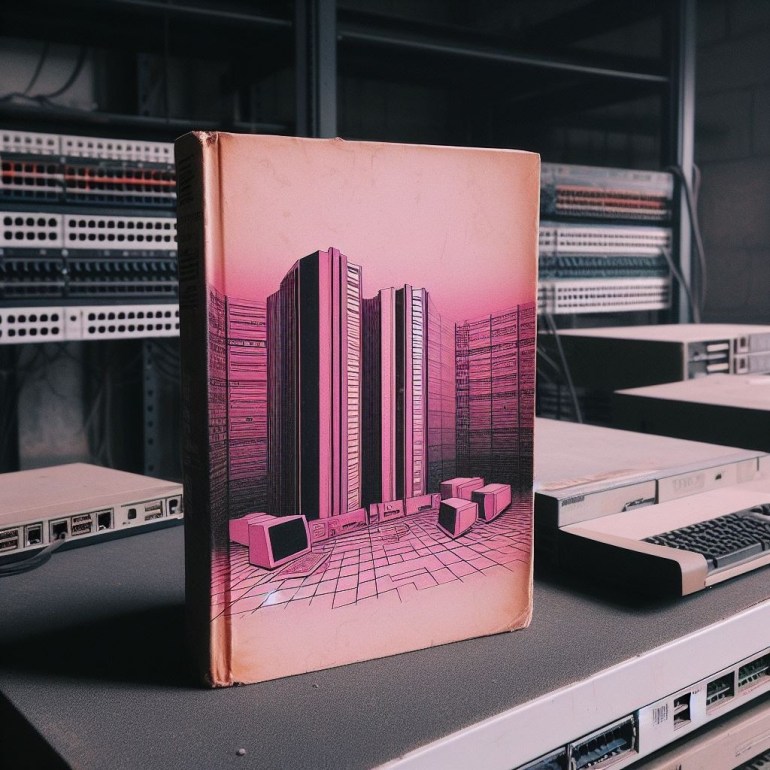
The Pink Datacenter – Introduction

Foreword

I wrote this book in November 2023, out of the NaNoWriMo challenge, where you have to write 50.000 words in a month, or 1.600 words every day for the whole November. I have always wanted to share my work experience within the technology realm, mostly due to being a white fly and never really fitting the stereotype of computer geek, but also because I have genuinely loved all my jobs, the experiences I have made and the people I met. I was lucky, I know, but also maybe smart enough to run from difficult moments and humble enough to always ask for help and find people (mostly men) willing to help me navigate this tough world.

Because of my technology obsession, I wanted to use ChatGPT, to increase speed and improve my English (being non native it’s not always easy to find the right words), and in the end I decided to also include the prompts (for those who are not familiar with AI, prompts are the questions posed to it, in order to shape the response in the way you want it) to make this experiment a shared one. I have reviewed both, the prompts and the responses, to match my train of thought and make it more readable, but in any case, you already know you wouldn’t get the same answers twice. 😊

Also, I have changed some of the character names to respect a bit of privacy but most of the facts are true and maybe sometimes just embellished to make them funnier to read.

Enjoy the ride, and the tech thrill of yet another technology breakthrough!

Write with a sarcastic, friendly, witty and feminist tone, no dialogues, an intro to this book. It’s about the experience of a technical female professional spanning the 90 and 2000s and up to this day, and it’s filled with anecdotes and funny situations but also a spark scoring of the D&I experience through the lens of today’s standards.

Introduction

Welcome, dear reader, to a journey through the annals of technology, where bits and bytes intertwine with the sassy keystrokes of a young woman navigating the digital wilderness. In this compendium of wit, sarcasm, and unapologetic feminism, we embark on an odyssey spanning the ’90s, the tumultuous 2000s, and up to the present day. Brace yourself for a rollercoaster ride filled with anecdotes, technical escapades, and a no-holds-barred exploration of diversity and inclusion through the acerbic lens of today’s standards.

Our journey kicks off in the ’90s, an era when the internet was a nascent realm, and women in tech were as rare as a glitch-free operating system. Our intrepid heroine, armed with a 1200-baud modem and a penchant for defying stereotypes, dives headfirst into the world of bulletin board systems (BBS). Picture a tech-savvy sorceress, weaving connections with fellow wizards in a niche realm where code was the language of friendship.

Fast forward to the late ’90s, an epoch where the telecommunications dance floor beckoned. Our protagonist, now a 21-year-old gal with good computer skills, pirouettes through a sea of bewildered onlookers who can rarely fathom a woman leading the IT conversation. Oh, the symphony of sarcastic remarks and raised eyebrows, as our leading lady dismantles PBXs adjuncts with wit and satisfaction.

As the new millennium dawns, our fearless tech maven transitions to a role in customer support for a telco company. The yawns and gasps from skilled and unskilled users become a comedic backdrop to her days, with IVR systems playing the supporting role. A cacophony of problems and patches and the occasional user-from-hell provide the punchlines in this uproarious comedy of errors.

Our tale then shifts to a new frontier in telecommunications – the Centers of Excellence (CoE) for Tier III engineers. Our protagonist ascends to the upper echelons of tech stardom, flying business class, reveling in 5-star hotels, and facing the dichotomy of boredom and burnout. The glory days of solving mission-critical issues by the lake or swapping tapes in a vault become the anecdotes that pepper this chapter.

A tempting offer from a rival company lures our protagonist away from Nortel Networks. A product manager’s role beckons, promising no nightly duty calls and a hefty paycheck. The transition is seamless, and the initial months are a whirlwind of navigating a larger subsidiary. The narrative pivots to a new role in 2001, as our tech virtuoso enters the realm of Nortel Networks and the complexities of its switch. Analog and digital telephony make space for VoIP to take center stage, with our heroine decoding the intricacies of serial or IP connections to specialized adjuncts. The tech landscape evolves, and so does our leading lady’s prowess. However, the abrupt turn of events post-9/11 throws our heroine into a whirlpool of rumors, layoffs, and a sudden end to the newfound role.

A Cisco partner (and its technology), Dimension Data, becomes the next chapter in our protagonist’s journey, a realm of IP telephony breakthroughs and the birth of the Cisco IPCC. The early 2000s usher in a new era of technology, and our leading lady is at the forefront, navigating the complexities with humor and a flair for the dramatic. The narrative unfolds as a startup venture, complete with acquisitions, travels, and the exhilaration of managing a team. The camaraderie with old pals from the BBS days adds a touch of nostalgia to this chapter.

As the recession of 2008 hits, our protagonist has already entered the world of Aspect, an American giant in the contact center business, but unknown,and a startup in the southern European market. The initial years are a whirlwind of learning, travel, and collaboration, only to face the harsh realities of downsizing an already small startup. The sudden departure of a mentor leaves a void, and the struggle to find meaning in corporate decisions becomes a prevalent theme.

The final act of the 2010s unfolds, with our heroine juggling the demands of a burgeoning family and a demanding job. The unexpected loss of a parent adds a somber note, and the protagonist finds solace in work as a distraction from personal grief.

A reflection on the Discrimination and Inclusion (D&I) score becomes the prelude to the MaaS (Mother as a Service) manifesto. All jobs are dissected with a feminist lens, sparking a call to rewrite societal narratives and usher in an era of equality. As you flip through the pages of this tech-driven epic, prepare to be regaled with tales of coding escapades, telecommunication triumphs, and the tumultuous journey of a woman thriving in a male-dominated landscape. Join our protagonist as she navigates the digital realm with a blend of humor, sarcasm, and unyielding feminism, leaving an indelible mark on the binary tapestry of the tech wonderland.

To be continued…

The Pink Datacenter – my book

📚 Introducing my New Book: “The Pink Datacenter”, written this last November for the NaNoWriMo initiative with the help of my friend the AI chatbot.

🚀 Over the years, I’ve accumulated a treasure trove of stories, anecdotes, and insights from the world of technology, and I can’t wait to share them with you. From the early days of the internet to the cutting-edge innovations of today, my book chronicles the adventures, challenges, and triumphs of navigating the ever-evolving landscape of tech with the wide-open eyes of a girl who loves technology.

📖 Starting this month, I’ll be publishing excerpts from the book right here on my blog, one paragraph at a time. Each snippet will offer a glimpse into the fascinating world of tech, with humorous anecdotes, witty observations, and valuable lessons learned along the way. Whether you’re a seasoned tech enthusiast or simply curious about the inner workings of the industry, or in search of a #girlintech role model, I guarantee there will be something for everyone in “The Pink Datacenter.”

✨ Stay tuned for my first installment this week, and get ready to embark on a journey through the highs and lows of the tech world like never before. With “The Pink Datacenter,” I invite you to join me as I explore the past, present, and future of technology, one paragraph at a time.

NaNoWriMo 2023 – the return of the tech girl

This year, I’m diving headfirst into the literary jungle, armed with a keyboard and a decade-spanning tech tale as my trusty sidekick! I’m taking on NaNoWriMo 2023 with lots of good intentions, and a clear mission: writing a book about my rollercoaster journey as a tech-savvy gal from the ’90s to the present day.

This is a story of floppy disks, dial-up modems, and the perpetual quest for more pixels (and bandwidth) that I have been meaning to write for a very long time.

And guess what, I’ve got a secret weapon up my sleeve – ChatGPT as my co-pilot! With its AI wizardry, I’m turbocharging my writing process faster than you can say “Ctrl+Alt+Delete.”

This will totalle make up for my chronic lack of time: ideas are already in my head, and with the copilot help, it will be much easier to put them into words – also writing in English which is a second language to me. 🙂

So, buckle up, fellow writers and readers, because this book is going to be a wild ride through the digital ages, with just the right dash of nerdy humor to keep you entertained!

Let the typing begin! 🚀💾🤖 #NaNoWriMo #TechTales #ChatGPTAdventures

https://nanowrimo.org/participants/paolaeva/projects/the-pink-datacenter/

my own book club (2022)

If you are familiar with this blog, you might know I started reading books (I won’t say exclusively, but a good 90% of them) in digital format back in 2016, with great results in terms of speed, satisfaction, user experience, availability of titles.

because I am an engineer at heart, I wanted to understand better what was the impact of digital on my book reading. here’s the result for last year, 2022, with number of books and pages read per month. I’ll be also posting stats for years 2016-2020 so we can reasonably start making some connections between the books I read and what was happening in my life and in the world.

here’s my book list for 2022, I read 20 books, a total of 7963 pages, with an average of 663,58 pages/month.

1 Snow Crash – Neal Stephenson 448
2 iGen: Why Today’s Super-Connected Kids Are Growing Up Less Rebellious, More Tolerant, Less Happy–and Completely Unprepared for Adulthood–and What That Means for the Rest of Us – Jean M. Twenge 533
3 Dopesick – Macy, Beth 410
4 The Midnight Library – Matt Haig 295
5 Cryptonomicon – Stephenson, Neal 931
6 The Three-Body Problem – Liu, Cixin, Liu, Ken 400
7 Before the Coffee Gets Cold – Kawaguchi, Toshikazu, Trousselot, Geoffrey 192
8 Beautiful World, Where Are You – Rooney, Sally 192
9 Big Summer: the best escape you’ll have this year – Weiner, Jennifer 367
10 The Power – Alderman, Naomi 352
11 Mexican Gothic – Moreno-Garcia, Silvia 321
12 Crossroads: A Novel – Franzen, Jonathan 592
13 Conversations with Friends – Rooney, Sally 322
14 The Invisible Life of Addie LaRue – Schwab, V. E. 448
15 Quiet: The Power of Introverts in a World That Can’t Stop Talking – Cain, Susan 368
16 The Humans – Haig, Matt 304
17 How to Stop Time – Haig, Matt 336
18 The Thing Around Your Neck – Adichie, Chimamanda Ngozi 240
19 Swing Time – Smith, Zadie 464
20 Half of a Yellow Sun – Adichie, Chimamanda Ngozi 448

my own book club (2021)

if you are familiar with this blog, you might know I started reading books (I won’t say exclusively, but a good 90% of them) in digital format back in 2016, with great results in terms of speed, satisfaction, user experience, availability of titles.

because I am an engineer at heart, I wanted to understand better what was the impact of digital on my book reading. here’s the result for last year, 2021, with number of books and pages read per month. I’ll be also posting stats for years 2016-2020 so we can reasonably start making some connections between the books I read and what was happening in my life and in the world.

here’s my book list for 2021, I read 27 books, a total of 9897 pages, with an average of 824,75 pages/month.

2021    title | author | pages

1 Such a Fun Age | Kiley Reid | 321
2 The Cousins | Karen M. McManus | 261
3 One of Us Is Lying | Karen M. McManus | 359
4 Pretty Little Wife: A Novel | Darby Kane | 407
5 The Glass Hotel: A novel | Emily St. John Mandel | 321
6 Leave the World Behind: ‘The book of an era’ Independent | Rumaan Alam | 232
7 The Vanishing Half: A Novel | Brit Bennett | 350
8 Factfulness: Ten Reasons We’re Wrong About The World – And Why Things Are Better Than You Think | Hans Rosling | 353
9 The Wrong Family: A Thriller | Tarryn Fisher | 305
10 I Can Be A Better You: A shocking psychological thriller | Tarryn Fisher | 300
11 In other rooms, Other Wonders | Daniyal Mueenuddin | 260
12 Two Wrongs | Rebecca Reid | 301
13 No Rules Rules: Netflix and the Culture of Reinvention | Reed Hastings | 310
14 The Night Watchman: Winner of the Pulitzer Prize in Fiction 2021 | Louise Erdrich | 467
15 The Phoenix Project: A Novel about IT, DevOps, and Helping Your Business Win | Gene Kim | 437
16 The Unicorn Project: A Novel about Developers, Digital Disruption, and Thriving in the Age of Data | Gene Kim | 335
17 The Soul of A New Machine | Tracy Kidder | 297
18 Masters of Doom: How Two Guys Created an Empire and Transformed Pop Culture | David Kushner | 368
19 Infinite Jest | David Foster Wallace | 1092
20 The Mars Room: Shortlisted for the Man Booker Prize | Rachel Kushner | 354
21 The Storyteller: Tales of Life and Music | Dave Grohl | 384
22 A Man Called Ove: The life-affirming bestseller that will brighten your day | Fredrik Backman | 305
23 My Grandmother Sends Her Regards and Apologises | Fredrik Backman | 353
24 Le api non vedono il rosso (I coralli) | Giorgio Scianna | 253
25 Klara and the Sun: The Times and Sunday Times Book of the Year | Kazuo Ishiguro | 418
26 The Buried Giant | Kazuo Ishiguro | 354
27 Anxious People: The No. 1 New York Times bestseller from the author of A Man Called Ove | Fredrik Backman | 400

Amazing things can happen…

…for those who dare!

Last year, while still busy with a full time job, a family and the pandemic, I embarked in an unknown and uncharted adventure: I decided to co-author a book with one of my favourite customers – and friend- Giuliano.

After 6 hectic months, I am proud to announce my new book “The Road to Azure Cost Governance” will be out on 18th Feb. Writing it has been an awesome experience. Sometimes when I read passages of it, I still think “I didn’t know I had this in me”, which I am told is part of the writing process.

If you are curious, willing to learn something new, or simply looking for some guidance on Azure Cost Governance and Optimization, this book might be for you!

The Road to Azure Cost Governance | Packt (packtpub.com)

I had so much fun writing it…I hope you’ll have fun reading it as well 🙂

Paola

The Carbon Monkey

How principles of Chaos Engineering and using carbon monkeys to simulate real-life energy events help us achieve our sustainable software engineering goals.

Photo by Singkham on Pexels.com

According to Principles of chaos engineering, Chaos Engineering is the discipline of experimenting on a system in order to build confidence in that system’s capability to withstand turbulent conditions in production. I have followed this discipline through the years finding it fascinating, especially when applied to large scale applications and systems. As the site explains:

“Even when all of the individual services in a distributed system are functioning properly, the interactions between those services can cause unpredictable outcomes. Unpredictable outcomes, compounded by rare but disruptive real-world events that affect production environments, make these distributed systems inherently chaotic.

We need to identify weaknesses before they manifest in system-wide, aberrant behaviors. Systemic weaknesses could take the form of improper fallback settings when a service is unavailable; retry storms from improperly tuned timeouts; outages when a downstream dependency receives too much traffic; cascading failures when a single point of failure crashes; etc. We must address the most significant weaknesses proactively, before they affect our customers in production.

We need a way to manage the chaos inherent in these systems, take advantage of increasing flexibility and velocity, and have confidence in our production deployments despite the complexity that they represent. An empirical, systems-based approach addresses the chaos in distributed systems at scale and builds confidence in the ability of those systems to withstand realistic conditions. We learn about the behavior of a distributed system by observing it during a controlled experiment. We call this Chaos Engineering.”

Build a Hypothesis around Steady State Behavior

Let’s start with the first step: a steady state behavior is the condition our application should aspire to be in. If we translate this principle into a sustainable one, this becomes the most beautiful and efficient state of an application: one where no energy is wasted, and efficiency and performance is at its best.

Call for more “carbon monkeys”

The most difficult part is how to measure and set this initial state. My colleagues have shared numerous ideas on the Sustainable Software Engineering blog that might help you jumpstart your measurement. However, I feel that at some point, this will have to reach a standardized and widely accepted form where we have a “carbon limit” where an application is considered inefficient and not sustainable.

Vary Real-world Events

This is the principle that represents how close chaos engineering and sustainable software engineering are. There is no steady and predictable flow of energy coming from the same renewable source. From the challenging big picture of using solar, wind or hydro energy down to when we plug our device into the outlet, we still have limited ways to retrieve exactly how the energy that is powering the device is produced in that exact moment in time. Doing so precisely requires considering things like seasonality, time of day, peak hours as well as weather conditions that trigger renewable power supplies usage. The variables around this concept are too many!

Imagine now that your application is running on a virtual datacenter where you have even less information of its carbon impact. We still need to start somewhere, though, and set an amount of carbon usage for the application. This will be useful to measure its increase and decrease to drive efficiency.

Back to chaos engineering. Simulating power outages is just a start. We can think of it as the starting point for a sustainable application:

  • What if the renewable power sources are suddenly unavailable and therefore, I have spikes of energy consumption that I could not foresee even in the greenest application?
  • What if at some point my application has become a “carbon monster,” greedy with energy because a query has gone wrong and it’s suddenly taking most of its energy just to search for that item in your cart? Or because at some point the network path has changed due to an outage in the network route and its latency spikes? And so, trying to replicate real-life energy events directly into an application will make it more resilient to lower energy availability and overall, more efficient.

Enter the “Carbon Monkey”

This concept is a “carbon” monkey: a process or system that triggers energy inefficiencies at random, testing how your application reacts, and measuring differential performance that can relate to the differential carbon impact.

Instead of measuring how much energy an application consumes, we should test adding energy events to see how the application behaves and then drive change to improve its reaction to events that make it less green. 

We have given the problem of how to measure an application’s carbon efficiency a lot of thought. But this approach offers a change of perspective. Instead of measuring how much energy an application consumes, we should test adding energy events to see how the application behaves and then drive change to improve its reaction to events that make it less green. 

As a result, we won’t have a carbon impact exact measurement, but only a differential. With time, this differential can become an absolute number when  other systems allow us to retrieve more precise energy consumption metrics.  In the meanwhile, let the carbon monkey help us reduce impact regardless of the metric standardization!

Photo by Alexandr Podvalny on Pexels.com

Call for more “Carbon Monkeys”

I’d like to see developer communities creating one or more “carbon monkeys” that can introduce energy-impacting events into applications, to foster resiliency towards sustainability. 

The main trigger is defining a set of incorrect assumptions about energy usage that can prevent our application from performing “green”. These would include assumptions such as the highest energy cost/carbon use/region, the shortest/longest queries, the shortest/longest network paths, the highest compute and memory usage among other things. 

These assumptions should then be introduced by an automated process (our monkey) that will make sure that the application patterns are resilient enough to overcome those issues without completely failing. At the end of the run, we could set up a carbon resiliency value that can help set a standard for the application carbon impact differential evaluation.

Originally published in the Microsoft Developer Blogs

A dapper sustainability

When talking about carbon footprint of an application, we should normally consider two angles. How much energy was used to run it (i.e., number of cores, time of execution, hardware efficiency, etc.) and how much producing that energy impacted on the environment, which is called carbon intensity and depends on the location, time, and type of energy utilized (gas, coal, wind, etc.) for datacenters. A study from 2016 proved that around 55% of the consumed energy depends on the computing systems, and the remaining 45% is used for supporting the compute (cooling, ups, etc.). In addition, if 80% of U.S. small datacenters were moved to hyperscale providers, the electricity consumption usage could drop as much as 25%.

The year 2020 marked the beginning of a common global awareness in the IT world: software and applications have a footprint that must be taken in consideration, and algorithms are being developed to assess such footprints.

I have been recently exploring with a bunch of fellow Cloud Solution Architects the innovation of Dapr, a recently created open-source project for a distributed application runtime. According to its main page, “Dapr is a portable, event-driven runtime that makes it easy for any developer to build resilient, stateless and stateful applications that run on the cloud and edge and embraces the diversity of languages and developer frameworks.”(Find additional information) The main dream-like features of Dapr are indeed its simplicity of implementation and its ability to work across any programming language, framework, and infrastructure.

In a recently released Dapr book, there is a specific passage on sustainability with Dapr, which prompts developers to start thinking about sustainability when they approach their software architecture. While figuring out the way Dapr works, I have tried to apply the sustainability angle to it, and found out three main aspects where a green developer might want to focus:

  1. How the application can measure its own carbon impact.

This might not seem difficult, but you need to remember that in a distributed solution we can have several different infrastructure environments and programming languages. Ideally this should be done via a dedicated microservice that can continuously monitor the carbon impact across every source of energy, and that is able to feed the other parts of the application with this information. Dapr is very precise in measuring the performance impact of its infrastructure and to offer guidance on how to measure the performances used by the microservices adopting Dapr. As mentioned in the public documentation, there are ways to retrieve CPU and memory usage that can help carve out the overall carbon impact. Also, in a recursively fashion, this microservice should also monitor its own carbon impact. 😊

Image pexels ann h 2646530
  1. How the application can drive/change its carbon impact by steering its IaC (Infrastructure as a Code)

Imagine that you have a microservice that can instantly monitor the carbon impact and feed the results to any subscriber of this information. Because the carbon impact is not a fixed amount, and largely depends on the energy conditions of the datacenter where the infrastructure resides, the application can have an automation that triggers the move of all or parts of the infrastructure towards less impacting sites or regions. This might not be immediate or even feasible for some regions (think of data sovereignty and latency, for example), but where applicable, the result would be a highly optimized sustainable infrastructure for the distributed application, that can guarantee to run in the less impacting infrastructure (and probably the cheapest, for the same reason) at any given time. As a side effect, this adds to its resiliency as the application can span several different environments.

  1. How the application can drive/change its carbon impact depending on the user behavior.

This is an Sustainable Software Engineering technique that requires special attention because it involves the user experience and the education of users towards sustainability. The application can provide different levels of features depending on the carbon impact of such features (as measured by the above mentioned microservice) and offer a diversified user experience, according to the impact level of the feature, leaving the informed choice to the end user. Have more time to spare? Why don’t you try this slightly-higher-latency level which saves xx% of carbon by using a greener infrastructure? Do you really need to load all high-res pictures? Try the low-quality site for some additional carbon saving, and so on.

This obviously presents some overhead on the programming side, but the beauty of its execution is that the application will define and educate the end users to have a saying on their impact, and after a while by monitoring the choices users made, you can also have feedback on how they want to interact with your software. With time, you’ll have a clear picture of which combination provides a better trade-off of performance and energy savings. Dapr favors asynchronous architectural patterns, especially relying on a publish/subscribe interaction between microservices. Handling requests with this approach by scaling out and in can achieve the best compromise between dynamic response to user demands and control on the resources we want to provide for our workload.

Since Dapr is a open source and community-driven project, this is a call for action for developers to create an explicit branch of it dealing with the green impact of a distributed application: a blueprint to measure, control and optimize the energy efficiency of the microservices that cannot be left out of a modern innovative software architecture.

originally published on the Microsoft Tech Blog

Reducing the carbon and financial cost of your cloud applications

your CIO surprised by the cloud bill

In my job as a cloud architect working with large enterprises, there has always been a specific “moment of truth” when the customer realizes that cloud costs are something that needs to be monitored daily to avoid unpleasant surprises with the end of the month’s bill.Enterprises can take several steps toward understanding cloud costs and avoid surprises:

  • establish control and governance.
  • analyze possible savings.
  • plan the required changes to reach identified savings.

The main goal of cloud governance is how to bring down the monthly billing or to keep it level, while absorbing the usual growth or the new projects. But what if we looked at cost optimization from a different angle? At Microsoft we can calculate the saved carbon emissions using tools, such as the Microsoft Sustainability Calculator, so, what if our efforts were drawn towards “carbon+cost efficiency” rather than simply cost saving?

The pillars of cost control

Depending on the cloud maturity and model adopted by each customer, a few fundamental actions that are directly linked to cost (and carbon) saving can be taken.

Right-sizing

Right-sizing is about understanding exactly what your applications need and not provisioning due to guessing. But wrong-sizing has a much higher cost than the monthly bill: trying to mirror the exact sizing of your on-prem infrastructure without applying right-sizing can lead to larger monthly bills, reduced capacity for other customers, and unnecessary electricity usage. Right-sizing is not just picking a VM size for a workload, but planning to change the sizing during the day according to its workload and the carbon efficiency of the region where it runs. For a PaaS environment, it can mean changing a service plan according to the time of day and/or expected usage. Sometimes companies can even try and set usage expectations by clearly giving an informed choice to their internal customers and end- users that their choice in an application can lead to less carbon impact, offering a green option for the applications where users can swap to less features or even a slower connection but knowing they are polluting less.

Reservations

Reservations are typically a commercial discount on cloud services in exchange for a yearly or multi-yearly commitment. However, this saving does not necessarily equate to a green usage of the reserved resources: the cloud provider is happy for the commitment and the customer is happy for the discount, but reservations are not necessarily a greener option. To ensure your reservations are minimizing the electricity usage, you need to frequently monitor reservations and try to use them at the maximum utilization. Anything lower than 99% utilization must be right-sized.

Cleanup

Cleanup is the most difficult part of cost management, especially within large organizations and cloud deployments. When you have thousands of VMs and applications running, it’s quite difficult to scour the cloud tools for any inconsistency. For example, if you delete a VM and forget to delete its disks or IP address, those resources will continue to run, impacting your monthly bill as well as your carbon footprint. So, cleanup should be the first choice of carbon+cost efficiency. This is typically a task that can be automated and is included in most optimization tools, such as Azure Cost Management.

Scheduling Operations

The last pillar of carbon+cost management is scheduling operations. This means being able to switch off and on again most of your servers/applications/services. With PaaS, it could be just changing the service tier to a less costly one during off-peak hours. Initially, many customers are hesitant to switch off applications on a schedule. However, in my experience, if customers test scheduling on a small number of applications, they quickly see the cost benefits and are open to scheduling more of their applications. The first step is to enforce any type of scheduling. It could be just turning the application off on the weekends or nights.

Photo by Pixabay on Pexels.com

Once customers start understanding the cloud operations, what they should be thinking next is: “why keeping a valuable and costly resource switched-on even for just one hour, if it’s not used?” The carbon+cost efficient scheduler must consider:

  • The time it takes to bring the application down. For example, if the whole reboot takes one hour, then the timeframes planning cannot be less than two hours.
  • The real usage of the workloads. For example, if there is only one user logged into the portal at night, the user may consider not offering that service or application at night.
  • Scheduling should not be just on-off option, but also include reducing PaaS service plans and tiers of resources, where possible.

Carbon+cost management should become a new standard that involves the entire company to be more efficient and greener. Application owners and developers should be involved in keeping infrastructure as close to carbon neutral as possible by starting with cleanup, scheduling and right sizing, and then to proceed to include the principles of sustainable software within the application itself. It’s important to look beyond the raw performance and financial costs of your infrastructure and start considering the ethical costs of how much carbon your infrastructure is emitting. Visit Azure’s cloud cost optimization page for cost optimization techniques and suggestions, as well as this blog periodically to preview our new tools and ideas.

originally published in the Microsoft Tech Blog